Exhibition floor space is expensive, and exhibitors usually pay for its months before the event begins. Yet many businesses focus more on getting their stalls built than on planning how those stalls will attract visitors and support sales.
This is where 3D exhibition stall design becomes important. Instead of relying on a flat graphic wall, it uses height, depth, open layouts, and interactive elements to create a space that visitors notice and want to explore.
The aim is not simply to make a stall look different. It is to turn passing footfall into meaningful conversations and real business opportunities.
The 12 concepts below are grouped around three practical goals: attracting attention from the aisle, keeping visitors engaged inside the stall, and creating the right environment for sales conversations.
What Makes 3D Exhibition Stall Design Different from a Flat Booth?
3D exhibition stall design uses height, depth, layered structures and interactive content to create a space that works from different viewing angles. A traditional flat booth mainly communicates through graphics on a single surface.
This difference matters on a busy exhibition floor. Visitors usually notice a stand several meters away, often with other attendees blocking their eye-level view. Structures above eye level and elements that create depth make the stand easier to recognize from a distance.
There is also growing pressure to improve how exhibitions engage their audiences. According to UFI’s Global Exhibition Barometer, January 2026, 37% of survey respondents believe all events need to format improvements overall. Another 58% say the need for improvement depends on the type of show.
These findings make a strong case for reviewing how exhibition spaces are planned and experienced.
A 3D model also gives exhibitors a practical way to test they’re exhibition stall design before fabrication begins. Rather than approving a design based only on how it looks, teams can examine scale, visitor movement and sightlines. Problems can then be fixed before materials are cut or structures are built.
Which 3D Exhibition Stall Design Ideas Attract Attention from the Aisle?
The first four concepts focus on making an exhibition stand visible and encouraging visitors to slow down as they pass.
1. Use Elevated Structures to Improve Brand Visibility
At a crowded trade show, eye-level displays are easily hidden by the crowd. An elevated brand structure solves this by placing the company’s identity above the people in the aisle.
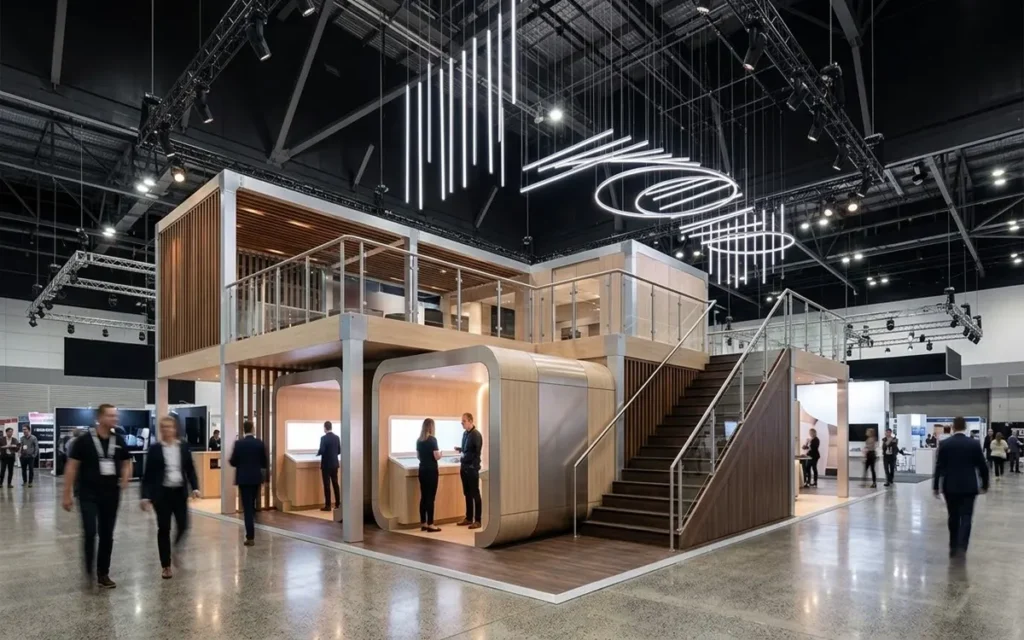
This could be a raised crown, a suspended ring, or a truss-mounted structure carrying the brand name or visual identity. These elements keep the stall visible from different parts of the exhibition hall.
Elevated structures need to be planned early, though. Venues set specific height limits and rules for suspended installations. Review these requirements before approving the design, because that height must be booked, not improvised during installation.
2. Create Depth with Layered Structural Frames
A flat graphic wall presents information on one surface. Layered framing gives the stall a three-dimensional appearance by placing frames or panels at different distances from the aisle.
As visitors walk past, the layers appear to shift in relation to one another. This effect, known as parallax, means the stall reads well from three approach angles rather than one.
Layered depth framing is also a practical choice for exhibitors who do not want to depend on expensive display technology. The visual interest comes from the geometry of the structure itself. Among exhibition stall design ideas, it is one of the few that costs geometry rather than technology.
3. Keep the Stall Entrance Open and Accessible
A stall can attract attention and still fail to bring visitors in. A reception counter placed across the front creates a physical barrier between the aisle and the display area, and a visitor who has to decide whether to cross a barrier often decides not to.
An open entrance removes that friction. Move reception counters toward the perimeter and keep the front of the stall low and open. Visitors can then approach the products or interactive elements without navigating around furniture.
This matters most for stalls where the main objective is to get people to walk in, explore, and speak with the team. An open layout makes the space feel more welcoming without requiring additional floor area.
4. Turn a Product into a Sculptural Display
Some products are technically interesting but too small to stand out on a crowded exhibition floor. A sculptural product display turns one important product or component into a large architectural feature.
For example, an exhibitor might use an oversized product model, an enlarged cross-section, or a cutaway structure that reveals how a component works. This gives visitors a clear view of the product’s engineering and makes the product itself the main visual landmark, rather than printed graphics.
Manufacturers of small but technically complex components benefit strongly from this approach, because it makes their product easier to notice and understand.
How Can Interactive Exhibition Stall Design Keep Visitors Engaged?
Attracting visitors is only the first step. Once people enter the stall, the layout and content need to give them a reason to stay. Dwell time is where immersive expo stand design earns its budget.
The next four 3D exhibition booth design concepts focus on interaction and visitor engagement.
5. Place Interactive Experiences at the Center of the Stall
An interaction-first layout puts the main activity where visitors can easily find it. Instead of placing a reception desk in the middle of the space, the design puts the product demonstration or interactive experience at the center and moves reception and supporting furniture to the edges.
This arrangement works particularly well for island stalls, which have four open sides. Visitors can approach the central activity from any direction. The same principle also works in a corner stall.
The key decision is to make the primary visitor activity the focus of the layout, rather than letting reception furniture dominate the space.
6. Use Projection Mapping to Create Changing Displays
Projection mapping adds movement and visual content to physical structures. It can turn a curved wall, a product model, or another surface into a display that changes a loop, without changing the structure underneath.
The practical advantage is repetition. A visitor who walks past the stand a second time sees different content from what appeared earlier, which creates a second chance to attract their attention.
Projection-mapped surfaces suit exhibitors who want one physical display to communicate more than one message.
7. Display Products with Headset-Free Holographic Technology
Holographic displays present three-dimensional content without asking visitors to wear VR headsets. On a busy floor, individual headsets create queues. A headset-free display lets several people view the same digital representation at once.
This format suits products or environments that cannot easily be brought to an exhibition, such as industrial turbines, manufacturing plant layouts, and facilities that are still under construction. It is equally useful when equipment is too large or too sensitive to transport.
The exhibitor can present the product in full detail without needing the actual asset on the show floor.
8. Let Visitors Explore Products Through Real-Time Configurators
A real-time product configurator turns a demonstration into an activity visitors complete themselves. Instead of watching a presentation, visitors explore different configurations, build a version that matches their requirements, and receive the finished specification by email.
This creates value on both sides. Visitors leave with a record of the configuration they selected, and the sales team learns exactly what each prospect is interested in. The choices made during the interaction become a qualification signal.
In this way, interactive event technology becomes more than a visual attraction. It works as a lead-scoring tool that supports the sales process.
Which 3D Exhibition Stand Design Concepts Support Sales Conversations?
An exhibition stand should do more than attract a crowd. It also needs space for product discussions, demonstrations, and meetings with prospective customers. The final four concepts focus on how the layout and design assets support those activities.
9. Create Additional Meeting Space with Tiered Decks
Some stalls need private meeting areas without taking up more floor space. Where venue rules and ceiling heights permit, a raised deck or double-decker structure adds a meeting area by using vertical space instead of a larger footprint.
At venues where floor space is especially expensive, building upwards is often cheaper than booking more ground-level space.
This option depends entirely on the venue’s structural and height requirements. Tiered meeting decks should be considered at the initial planning stage, not after the main layout has been approved.
10. Divide the Stall into Three Visitor Zones
Not every visitor enters a stall with the same intention. Some want a quick look, while others want to learn more or discuss a potential purchase. Three-depth zoning organizes the stall around these different needs:
- Grab zone: At the front, attract attention and give visitors a quick introduction.
- Learn zone: In the middle, for product information, demonstrations and exploration.
- Talk zone: At the back, for detailed conversations with interested prospects.
This arrangement stops casual browsers and serious buyers from competing for the same space, which would cost the attention of both groups. It also gives the sales team a better environment for moving conversations forward, with each part of the stall serving a clear purpose.
11. Choose Modular Exhibition Stall Designs for Repeated Use
Businesses that exhibit six or more times a year need to think about how often their structures can be reused. Building an entirely new custom stand for every event drives up the overall cost of exhibiting.
A modular exhibition stall design uses a reusable frame system with interchangeable three-dimensional panels or structural elements. The main framework stays consistent, while selected components change to suit different venues and floor plans.
This keeps the brand recognizable across regional expos and international fairs, whether the floor plan calls it exhibition stall design or exhibition booth design. It also spreads the initial design and fabrication of investment across multiple shows. For frequent exhibitors, modular construction belongs in the annual event budget, rather than treating every exhibition as a separate building project.
12. Reuse 3D Digital Assets After the Exhibition
The digital models and interactive content created for an exhibition do not have to be used only once. These assets are often a costly part of the stand, particularly when they involve detailed product models, interactive content, or animations.
After the trade show ends, the same assets can be adapted for:
- Immersive showrooms.
- Product launch events.
- Brand activations in shopping malls.
- Interactive WebGL pages on corporate websites.
Treating the exhibition as the first place these assets are used, rather than the only one, changes how a business calculates the return on its investment.
How Can Exhibitors Measure the ROI of 3D Exhibition Stall Design?
The performance of a 3D exhibition stall can be measured using visitor footfall, dwell time, interaction completion rates, and qualified leads.
Plan these measurements during the design and fabrication stages. Sensors, footfall counters and interaction tracking systems are inexpensive to integrate while cabling and structural elements are still exposed, and far harder to add once the stall is fully dressed.
Four metrics provide a useful starting point.
1. Footfall compared with the exhibition baseline
Compare the number of people visiting the stall with the event’s overall footfall. This separates how the stand performed from how well attended the show was.
2. Visitor dwell time
Measure how long people spend inside the stall. This is the honest test of whether the layout, displays, and activities are holding attention.
3. Interaction completion rate
Track the percentage of visitors who finish an activity, such as a product demonstration, configurator experience, or 3D walkthrough. This shows whether people engage beyond their first moment of interest.
4. Qualified leads and pipeline influence
Track the leads generated at the exhibition and their contribution to sales opportunities over the following 90 to 180 days. This connects exhibition activity with longer-term commercial outcomes.
Agree on the target for each metric before the design is approved. Metrics chosen after the event tend to describe whatever happened, rather than whether the exhibition met its objectives.
How to Prepare an Effective 3D Exhibition Stall Design Brief
A useful 3D exhibition stall design brief starts with business objectives, not a list of visual features. Before the first concept is developed, exhibitors should define three things.
1. Identify the main action visitors should take
Decide whether the stand is meant to generate leads, book meetings, or drive for completed product demonstrations. The design should support that single primary action.
2. Define one clear message
Choose the key message visitors should understand when viewing the stall from about four meters away. Edit it until it fits on a single line.
3. Agree on performance measurements
Decide how the results will be evaluated and confirm those measurements with the person who signs the budget.
Planning in this order reduces unnecessary revisions and keeps the design tied to the event’s commercial purpose. For many businesses, exhibiting is a major part of the annual marketing budget. A well-prepared brief means that investment is judged by measurable outcomes, not just photographs of the finished stand.
Frequently Asked Questions About 3D Exhibition Stall Design
What is a 3D exhibition stall design?
3D exhibition stall design is the practice of planning a trade show to stand in a three-dimensional environment using height, depth, visitor flow and interactive elements. Designers usually develop a 3D model before fabrication to test scale, structure, and sightlines.
Is a 3D exhibition stand more expensive than a traditional booth?
Not necessarily. Cost depends on structural complexity, materials, custom fabrication, and technology. Geometry-based elements such as layered frames and open entrances can cost about the same as a flat structure. Screens, projection equipment, and custom content increase the budget. Set the lead target first, then allocate spend against it.
Which industries benefit from 3D exhibition stall design?
Heavy machinery, infrastructure, energy, pharmaceuticals, automotive components, and real estate benefits. 3D and holographic displays are particularly useful when the real product is too large, too small or too confidential to display physically.
Can small exhibition stalls use 3D design ideas?
Yes. A stall of 9 to 12 square meters can use elevated branding, layered structures, one prominent product display, or a single interactive station. Small stalls usually underperform because they carry too many messages, not because they lack space.
How far in advance should a 3D exhibition stand be planned?
Work backwards from the organizer’s installation date and reserve the longest block of time for content rather than construction. Physical structures can be fabricated relatively quickly. Interactive content, 3D models and motion graphics take longer to produce, and they are the parts visitors engage with.
What should businesses look for in an exhibition stall design company?
Look for evidence of measured project outcomes rather than renders, experience delivering stalls at comparable venues, and a clear understanding of fabrication requirements. Also confirm who owns the 3D models and digital assets after the event, especially if you plan to reuse them for future exhibitions or other marketing activities.