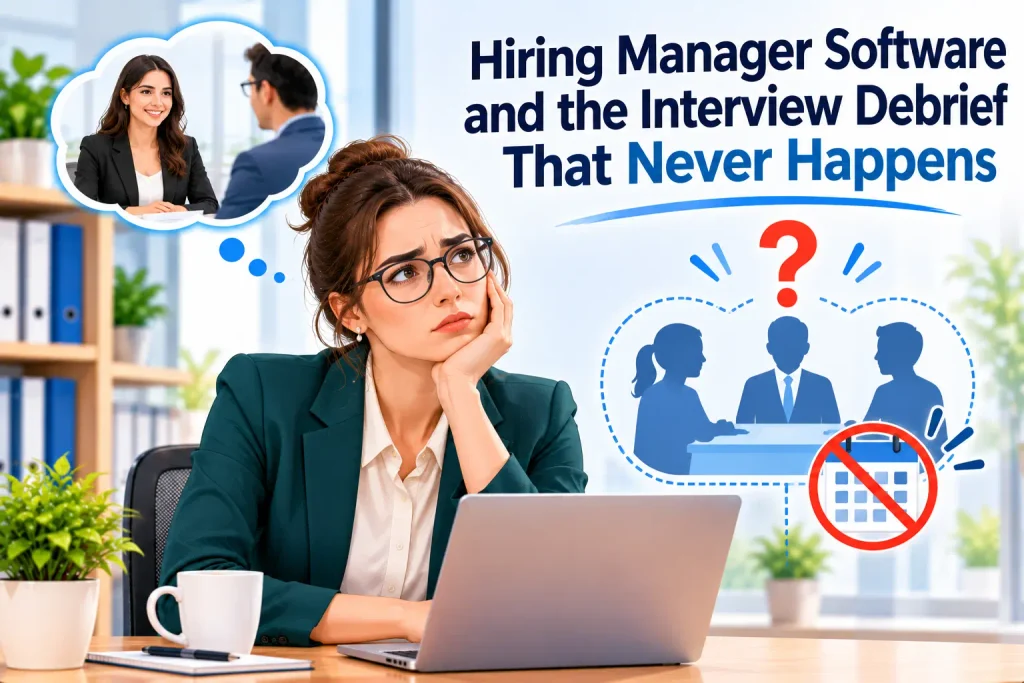
Picture the end of a final-round interview day. Four people have each spent forty-five minutes with the same candidate. They walk out, go back to their desks, and get pulled into other work. Nobody sits down together. Over the next few days, feedback trickles in by email, chat and the odd hallway comment, and by the time the hiring manager tries to make a decision, half the panel’s impressions have faded and the other half have been shaped by whoever spoke up first. That missing conversation is the interview debrief. It’s one of the cheapest, most useful steps in hiring, and it’s skipped more often than almost any other. The hiring manager software can’t hold the meeting for you. It can make it a lot harder to skip.
What a Debrief Is Supposed to Do
A debrief is a short, structured conversation held soon after the last interview, where everyone who met the candidate shares what they saw and the group compares notes. The goal isn’t to vote. It’s to find out where people agree, where they don’t, and why.
Done well, with hiring manager software keeping things organized, it takes twenty to thirty minutes. In that time it can catch things nobody would notice alone: one interviewer saw a strength, another never tested, two people picked up the same worry, or a “no” turns out to rest on something that isn’t really about the job.
Why It Quietly Disappears
Nobody decides to skip the debrief. It just never gets scheduled. A few reasons come up again and again.
- Calendars. Getting four busy people in a room is hard, and it gets pushed to “later this week.”
- Feedback arrives in pieces. Without a clear deadline, input trickles in over several days, and the loudest or earliest voice sets the tone.
- It feels optional. If the hiring manager already has a gut feeling, a meeting can seem like a formality.
- Nobody owns it. The recruiter assumes the manager will call it, and the manager assumes the recruiter will.
- Notes live everywhere. Impressions are spread across email, messaging apps and memory, so there’s nothing shared to discuss.
The cost is real, but it’s hard to see in any hiring manager software report. A weak decision made without a debrief doesn’t announce itself. It just shows up months later as a mismatch.
The Order of Things Matters
One detail makes a surprising difference: people should write down their own evaluation before they hear anyone else’s. Once a senior person says “I really liked her,” everyone else’s opinion starts bending toward it. That’s a known quirk of group decisions, and it’s why independent written feedback comes first.
This is where hiring manager software earns its place. If the system makes each interviewer submit a scorecard first, and keeps the others hidden until everyone has finished, the debrief starts from honest, independent views instead of a performance of agreement. The meeting then focuses on the gaps between those views, which is where the useful discussion is.
What Hiring Manager Software Can Do
Good hiring manager software supports the debrief without trying to replace the human part of it.
- Prompts interviewers to submit feedback within a set window after each interview
- Hides individual scorecards until everyone has submitted theirs
- Shows all feedback side by side in a single view, so differences are easy to spot
- Offers a simple agenda for the discussion, such as strengths first, concerns second, then a decision
- Records the outcome and the main reasons in the candidate’s file
- Reminds the hiring manager to schedule the meeting if it hasn’t been booked
None of these features is flashy. Together, they remove the small bits of friction that cause the debrief to slip.
Automation Can Help, in Proportion
Automated hiring software and hiring automation software can take care of the dull parts: scheduling the debrief as soon as the last interview is booked, sending reminders to anyone with missing feedback and collecting scorecards into one place. That’s a sensible use of automation, because it removes chasing, not judgment.
The risk with hiring manager software is letting automation make the call. A tool can flag that three of four interviewers rated someone highly. It can’t tell you whether the fourth interviewer noticed something that matters. Keep the decision with people, and use the software to make sure everyone arrives prepared.
Small Companies Have It Both Ways
Hiring software for small business use faces an interesting version of this. On one hand, a small team can hold a debrief in ten minutes by walking over to someone’s desk. On the other, small teams often rely on informal chats that never get recorded, and the owner or founder’s opinion can overwhelm everyone else’s without anyone meaning it to.
If that’s your situation, keep it light. Ask each interviewer to put a few lines of feedback into the system before the conversation, then meet briefly. A simple template inside your hiring manager software is more than enough. The aim is a shared record and an honest conversation, not paperwork.
Where the Debrief Fits in Your Wider Setup
The feedback collected in hiring manager software should connect to the rest of your process. Your ATS hiring software holds the candidate record and the stage history, so the debrief outcome belongs there too. A broader hiring management software platform can tie the debrief to the offer step, so an agreed decision moves forward without a second round of explaining.
When you compare the best hiring software, ask to see this flow end to end. Who can see feedback and when? Can independent scorecards stay hidden until the debrief? Where does the final reasoning get saved? A demo of hiring manager software that only shows the candidate list tells you very little about how decisions actually get made.
The Compliance Angle
A debrief also helps with fairness. When each interviewer scores against the same criteria and the group’s reasoning is recorded, it’s easier to show that candidates were judged consistently and for job-related reasons. That’s part of why EEOC compliance recruiting software features, such as structured scorecards, consistent questions and retained notes, get attention in tool comparisons.
It’s worth keeping the notes professional. Stick to observations about job-related skills and behavior, and avoid comments on personal characteristics. Record-keeping requirements depend on where you operate and how big your company is, so confirm the details with legal counsel or an HR specialist. Hiring manager software can store the records. It can’t tell you what the law requires.
A Simple Debrief You Can Start With
If your team has never done this, you don’t need a big process. Try this on the next hire:
- Ask each interviewer to submit a scorecard within 24 hours, before talking to anyone else
- Book a 25-minute debrief as soon as the final interview is scheduled
- Start with each person’s strongest evidence in favor, then their main concern
- Discuss only the points where scores differ by a wide margin
- Have the hiring manager record the decision and two or three reasons in the system
After a few hires using hiring manager software this way, you’ll know what to adjust. Most teams keep the independent scorecards and the short meeting, and drop everything else.
The Bottom Line
The interview debrief is a small step that protects a big decision, and it disappears because nobody owns it. Hiring manager software can change that by collecting independent feedback first, keeping views hidden until everyone’s done, showing all the evidence in one place and reminding people to meet. Pair that with a short, structured conversation, and your team will make better calls with less back-and-forth. It costs half an hour. Skipping it can cost a bad hire.
FAQs
What is an interview debrief?
It’s a short, structured conversation after interviews where everyone who met the candidate shares their evaluation and the group compares notes before a decision is made.
Why should interviewers submit feedback before the debrief?
Because opinions shift once people hear from a senior colleague. Independent written feedback keeps each person’s view honest, and the discussion can focus on where views differ.
How can hiring manager software support a debrief?
It can prompt interviewers for feedback, keep scorecards hidden until everyone submits, show all feedback side by side, offer a simple agenda and record the final decision and reasons.
Do small companies need a formal debrief?
A light one. Even a few written lines from each interviewer and a ten-minute conversation gives a small team a shared record and reduces the chance that one strong voice decides everything.
Can a debrief help with EEOC compliance?
It can help by keeping consistent criteria and recorded reasoning in one place. Requirements vary by location and company size, so confirm details with legal counsel or an HR specialist.
Visit: Factstea