From retail aisles to cardiac labs, three-dimensional displays solve specific communication problems, each with real trade-offs.
Ask three suppliers to quote for a 3D hologram and the proposals will not resemble each other. One offers a spinning LED unit costing less than a laptop. The second wants a stage, a truss and a blackout. The third sells a medical display carrying regulatory clearance. All three use the same word, and only one involves holography as physicists define it. That gap explains most of the disappointment buyers report later.
What counts as a 3D hologram today?
True holography records and rebuilds a light wavefront through interference and diffraction, the method that earned Dennis Gabor the 1971 Nobel Prize in Physics. Most systems sold commercially as a 3D hologram work differently, creating a persuasive impression of depth through reflection, rotation, projection or stereoscopy.
Most hologram concerts use Pepper’s Ghost, a nineteenth century technique that bounces a bright image off angled foil; the 2012 Coachella appearance of Tupac Shakur worked that way, despite the headlines. Spinning fans rely on persistence of vision. Light field displays send a slightly different image to each eye. Headsets deliver mixed reality. The labels matter commercially, because each approach sets its own ceiling on brightness, viewing angle and content.
1. Product visualisation on retail floors and exhibition stands
This is the most common commercial application, and very little of it is holography. Retailers and exhibitors use persistence of vision fans, transparent LED panels and light field screens to show what cannot be physically present: a vehicle interior, a turbine, an unreleased handset.
The problem is attention rather than information. In a hall of near identical stands, an image that appears to occupy space interrupts the visual scan. Public evidence that the attention converts into sales is thin, so treat supplier conversion figures sceptically. Environment decides the outcome: fan displays give a low resolution image inside a narrow viewing cone, daylight washes them out, and the moving blades need a guard wherever the public can reach them.
2. Live events, museums and visitor attractions
Staging a figure who cannot appear in person is a mature commercial use. Touring productions, product launches and heritage centres use Pepper’s Ghost rigs to place a life size performer or historical figure alongside real people. The advantage over a large screen is that the audience keeps its eye on the stage plane rather than shifting between performer and video wall.
The geometry is unforgiving. The effect holds only within a defined arc, so venues often withhold seats at extreme angles from sale. Foil, rigging and blackout control also lengthen the load in.
3. Design review in engineering and infrastructure
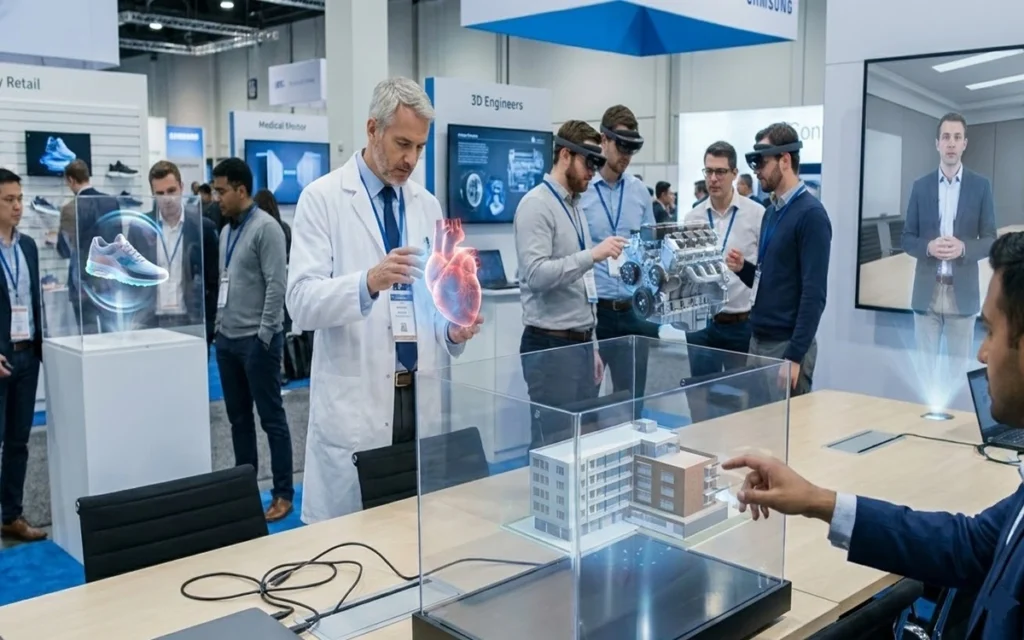
Large capital projects go wrong expensively when stakeholders misread drawings. Holographic display tables let a group stand around a shared model, rotate it, cut sections and step through construction phases together.
Infrastructure teams have used tables of this kind to review an airport masterplan as an interactive digital twin, switching between build stages and viewpoints during senior briefings. A screen shows the same geometry, but a shared object in the room gets people pointing, disagreeing and settling conflicts in one session.
Deployment is a data exercise before a display exercise. Heavy CAD and BIM files need optimising to render in real time, and most tables require tracked eyewear, which caps how many people see the effect properly.
4. Medical imaging and clinical training
Healthcare is where genuine holography has reached a commercial product. RealView Imaging’s Holoscope-i received FDA 510(k) clearance in 2021 and builds interference based volumetric holograms from CT and 3D ultrasound data, suspended above the clinician without a headset. Cardiologists otherwise manipulate catheters inside a three dimensional heart while reading flat screens.
Medical education uses different hardware for a related problem. Case Western Reserve University teaches anatomy with mixed reality headsets, and published research reports exam performance comparable with cadaveric dissection in less classroom time.
Headset programmes carry platform risk: Microsoft ended HoloLens 2 production, with software support due to finish at the end of 2027.
5. Head-up displays in production vehicles
Automotive is the clearest case of hologram technology reaching volume manufacturing. Envisics builds augmented reality head-up displays on dynamic holography, using laser illumination to place navigation and hazard graphics at more than one apparent distance ahead of the driver. Its second generation system is fitted to the 2026 Cadillac VISTIQ and LYRIQ-V.
The gain is glance time: graphics registered against the road keep a driver’s eyes where they belong.
Cost and packaging keep this on premium models. The optics take up dashboard volume designers guard closely, and the image must stay readable in direct sunlight.
What should businesses check before buying a holographic display?
Content is the recurring surprise. These systems need purpose built 3D visualisation assets rather than repurposed marketing video, and that production cost often exceeds the hardware. Ambient light sets a hard ceiling on quality. Viewing geometry shapes the floor plan. Motorised units need a service schedule. Pilot the system in the space it will occupy before approving a rollout.
Where does the technology go next?
Progress depends on unglamorous constraints. A review in Light: Science and Applications identifies the main barriers to dynamic holographic 3D display as the computing load of generating holograms, reconstruction quality and the limits of current spatial light modulators. Those are engineering problems with steady progress behind them, not imminent breakthroughs.
The nearer term shift is in three dimensional communication. HP’s Dimension system with Google Beam pairs a 65 inch light field display with a camera array to render a remote colleague at life size, listed near $25,000 per unit and needing a second unit at the far end. Cost, rather than optics, will decide how far it spreads.
The useful question is not whether 3D holograms work, but which visualisation problem an organisation actually has, and whether depth earns its cost against a very good flat screen.